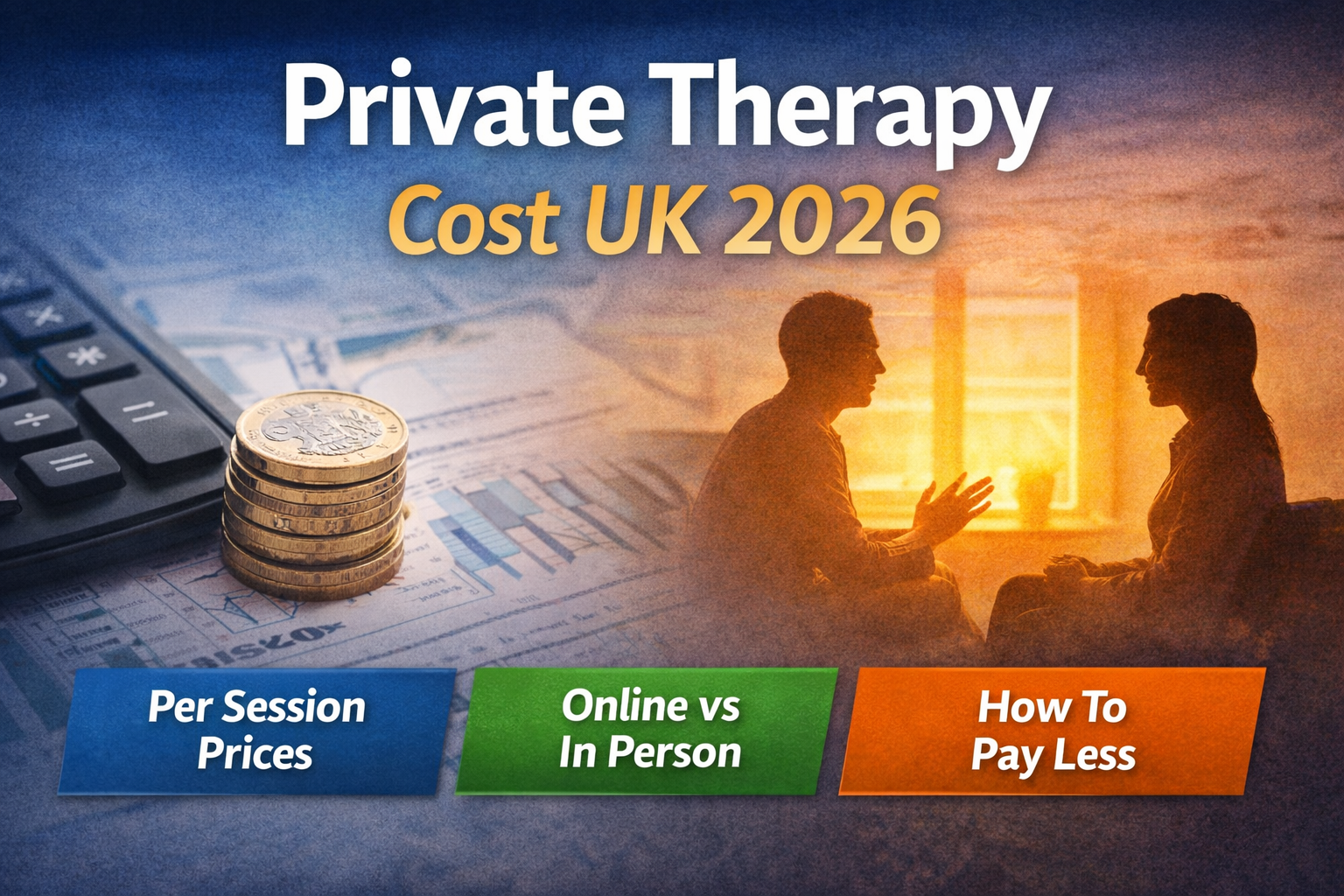
If you’re googling private therapy cost UK in 2026, you’re probably trying to answer a very real question: Can I afford this and what am I actually paying for?
Private therapy can be life-changing. It can also be expensive and confusing because prices vary by location, therapist experience, therapy type, and whether you choose online or face-to-face.
This guide breaks down typical UK prices, what packages look like, why costs vary, and practical ways to reduce the bill without compromising your safety.
Typical Private Therapy Cost UK In 2026
There’s no single official price because fees are set by individual therapists and practices. What we can do is look at credible UK sources and real-world pricing patterns.
A realistic session price range
The British Association for Counselling and Psychotherapy (BACP) says more than half of therapist listings on its directory advertise £40 to £60 per session, and notes that many therapists offer reduced rates and sometimes a free introductory session. BACP
From that baseline, prices often rise depending on region and therapist type.
Common price bands you’ll see
Use these as a practical guide when comparing therapists:
- Lower-cost / concession / trainee settings: often £30–£50 (sometimes lower with charities or training clinics) BACP
- Typical private counselling / psychotherapy: often £40–£80 per session BACP
- London and high-demand areas: commonly £70–£150+ depending on experience and location (many private practices price in this band) One Therapy
To make this concrete, here are real examples from BACP directory listings (individual therapists set their own fees):
- £75 online and £90 in person (50 minutes) BACP
- Sliding scale £65–£85 BACP
- £60–£70 (depending on time/day) BACP
- £70 per session, with potential reduced fee if finances are an issue BACP
- Online £65 vs face-to-face £80 (explicitly noting room rental costs) BACP
How long is a “session” in the UK
Most one-to-one therapy sessions in the UK are around 50 minutes to an hour, though it can vary. BACP
That matters because some therapists quote a price that sounds cheaper… then you find out it’s a 45-minute session.
Why Private Therapy Prices Vary So Much
When you compare two therapists charging different rates, you’re not just paying for “talking time”. You’re paying for training, experience, overheads, and the kind of service being offered.
1) Location and overheads
- London and major cities usually cost more (rent, demand, room hire).
- In-person sessions often cost more than online because the therapist has to pay for a room. You’ll sometimes see this stated directly in listings. BACP
2) Experience and specialism
Fees tend to increase when a therapist has:
- many years of practice
- advanced specialisms
- higher-demand niches (trauma-focused work, couples work, psychosexual therapy, etc.)
3) Who you’re seeing
In the UK, “therapy” can include different professionals. Costs can change depending on whether you’re working with a counsellor/psychotherapist versus a clinical psychologist or psychiatrist.
For example, one UK insurance research piece reported an average private psychology consultation cost of £129.20 in 2025, with costs described as having risen significantly since 2022. myTribe Insurance
(That’s specifically about private psychology consultations, not all therapy, but it shows why some private mental health services price higher.)
4) Format and support
Some therapists include extras such as:
- a longer first session
- written summaries
- between-session email support
- worksheets or structured programmes
Other therapists offer a straightforward weekly session with no “extras”. Neither is automatically better, but you should know what you’re paying for.
Packages And Payment Models In Private Therapy
A big confusion point is that some therapists price per session, while others prefer block bookings.
Pay as you go
- Most common model: you pay weekly (or at each session).
- Good if you want flexibility or you’re trying therapy for the first time.
Block bookings and packages
Some therapists offer:
- 4-session bundles
- 6-session “starter” blocks
- 10–12 session packages
Packages can be useful if you want commitment and structure, but don’t buy a large package until you’ve had at least 1–2 sessions and you’re sure the fit is right.
Sliding scale and reduced fees
Reduced rates exist, but you often need to ask. Mind (the mental health charity) suggests asking private therapists questions like how much it will cost, whether they offer reduced rates for low income, and whether they offer a free introductory session. Mind
BACP also notes that many therapists offer reduced rates and that some offer a free introductory session. BACP
Couples therapy costs
Couples sessions are usually higher because they are longer and more complex. For example, one London practice lists couples sessions at £160–£180. One Therapy
Online Vs In Person Therapy In 2026
Online therapy is now normal in the UK, and many therapists offer both formats.
Does online therapy cost less
Often, yes — but not always.
Why online can be cheaper:
- no room hire
- less travel time for both people
Why online isn’t always cheaper:
- therapist demand and specialism still matter
- some therapists price the same for simplicity and fairness
You’ll also see therapists charge different fees for online vs face-to-face explicitly (for example, £65 online vs £80 face-to-face). BACP
What to check before choosing online
Online therapy can be brilliant, but the setup matters. Before you commit, check:
- you have a private space where you can talk freely
- your connection is stable
- you’re comfortable with video/phone format
- the therapist is clear about confidentiality and boundaries
What to check before choosing in person
Face-to-face therapy adds practical considerations:
- travel time
- accessibility
- the therapy room environment
- whether you feel safe and comfortable there
How To Pay Less For Private Therapy In The UK
If the number you’re seeing feels too high, don’t assume therapy is “not for you”. Many people reduce the cost significantly by choosing the right route.
1) Ask for a concession rate
This is the simplest lever.
- BACP notes many therapists offer reduced rates. BACP
- Mind recommends asking about reduced rates if you’re on a low income. Mind
A good message is short and direct:
“Do you offer any concession spaces or sliding-scale rates at the moment?”
Worst they can say is no.
2) Choose online therapy
If in-person sessions are £80–£120 in your area, online can open up lower-cost options across the UK. Many therapists now work nationwide online.
3) Look for low-cost charities and local support
The NHS notes that talking therapies are sometimes available for free through your employer, university or local charities. nhs.uk
Mind also points people toward options for free or low-cost therapy and support services. Mind
4) Use the NHS where appropriate
If you’re eligible, NHS talking therapies can be free. The NHS explains private therapy is an option, but it also points people toward other ways to access talking therapies. nhs.uk
(Private can be faster, more choice, or more specialised — but NHS routes can massively reduce costs.)
5) Use work benefits if you have them
Many workplaces offer:
- EAP counselling sessions
- insurance that covers therapy
- wellbeing budgets
Even a few funded sessions can reduce your overall spend and help you decide what you need next.
6) Try a shorter time-limited plan
Not every therapy journey is open-ended.
If your goal is specific (panic attacks, confidence at work, grief support), you might plan for:
- 6 sessions, then review
- 10 sessions, then reassess
This stops therapy from becoming a vague monthly bill and keeps progress measurable.
How To Choose A Safe Private Therapist In The UK
Because “therapy” isn’t one single regulated title in every case, you need a simple safety checklist.
Check they’re on a recognised register
The NHS advises that before choosing a private therapist, you should make sure they’re registered with a professional organisation that’s been accredited by the Professional Standards Authority (PSA). nhs.uk
The PSA provides a “Find a Register” tool for accredited registers. PSA
It also explains that psychotherapists are not regulated by law, but can join an Accredited Register to demonstrate standards and public protection. PSA
Examples:
- BACP has its own register and explains it’s there to protect the public and set/enforce standards. BACP
- UKCP states its register is accredited by the PSA and can be searched to verify therapists. UK Council for Psychotherapy
Ask these questions before you book
- How much is each session, and how long is it
- Do you offer reduced rates or sliding scale options
- What’s your cancellation policy
- What therapy approach do you use and what’s it best for
- How often do you recommend sessions at the start
- How will we know if therapy is working
- What happens if you think I need a different kind of support
A therapist doesn’t have to “sell” you. They should be able to explain clearly, calmly, and professionally.
FAQs About Private Therapy Cost UK
How much is private therapy per session in the UK in 2026
A common band is £40–£60 per session, and BACP notes more than half of its directory listings advertise fees in that range. BACP
In high-cost areas (especially London) prices often go higher depending on experience and setting. One Therapy
Is online therapy cheaper than in-person
Often, yes — mainly because of room rental and overheads. Some therapists list lower online fees and higher face-to-face fees explicitly. BACP
But plenty of therapists charge the same for both, especially if they’re in high demand.
Can I get reduced-fee private therapy in the UK
Sometimes, yes. Many therapists offer reduced rates, and Mind suggests asking directly about reduced fees and free introductory sessions. Mind
How do I check if a therapist is legitimate
The NHS recommends choosing a private therapist registered with a PSA-accredited professional organisation. nhs.uk
You can use the PSA’s “Find a Register” and verify membership on registers like BACP or UKCP. PSA
Final Checklist Before You Pay
Before you commit to private therapy, make sure:
- you understand the session length and total cost BACP
- you know whether you’re booking online or in person (and why pricing differs) BACP
- you’ve asked about concessions or sliding scale Mind
- the therapist is on a PSA-accredited register or can clearly show professional standards nhs.uk
Disclaimer
This article is for general informational and educational purposes only and is not medical, mental health, legal, or financial advice. Therapy costs and availability change, and individual circumstances vary. If you need urgent help, contact emergency services (UK: 999) or NHS non-emergency support (111). If you need someone to talk to, you can contact Samaritans 116 123 (UK & ROI, free, 24/7).
Affiliate disclosure: Some links in this post are affiliate links, which means I may earn a commission if you make a purchase. This helps support Grow Your Thoughts at no extra cost to you.